
ETtoday新聞雲
26 Aug. 2026 12:44

The student dormitory at NCCU’s Huanan New Village is cited by the Ministry of Education as one of the empirical cases for gender-friendly housing. (Photo / Captured by Reporter Min-rong Xu)
By Min-rong Xu, TAIPEI
As colleges and universities prepare for the upcoming semester, the Ministry of Education (MOE) has released the "Reference Manual for Establishing Gender-Friendly Dormitories in Higher Education Institutions." The manual introduces housing models such as co-ed floors with single-gender rooms and gender-neutral apartment-style dorms, showcasing real-world cases like NCCU's Huanan New Village and NCKU's Dongning Dormitory. The MOE stated that schools can implement these changes progressively based on campus conditions and student needs, while emphasizing the importance of active communication with parents and balancing student privacy with residential safety.
The Ministry of Education (MOE) published the "Reference Manual for Establishing Gender-Friendly Dormitories in Higher Education Institutions" on its website today (26th). Commissioned to the Taiwan Gender Equity Education Association (TGEEA), Professor Bi Heng-da, and Professor Lin Mei-chun, the manual was completed after integrating existing research and international practices, convening expert consultations and review meetings, and conducting on-site visits to 20 colleges and universities.網站公布「大專校院性別友善宿舍建置參考手冊」,該手冊由教育部委託台灣性別平等教育協會、教授畢恆達及林玫君編撰,透過整合既有研究成果與國際實務經驗、召開專家諮詢及審查會議、參訪20所大專校院後完成。
The Ministry of Education (MOE) further explained that the manual balances geographical diversity across northern, central, southern, and eastern Taiwan, as well as the unique characteristics of public and private universities and technological colleges. Institutions were evaluated based on their dormitory scale, accommodation types, implementation of gender-friendly amenities, and the feasibility of hosting site visits. Ultimately, 20 domestic universities—comprising 11 public and 9 private schools—were selected for on-site visits and exchanges. The manual was finalized after benchmarking these findings against domestic and international dormitory layouts and residential experiences.
The manual incorporates real-world cases from universities such as NCCU's Huanan New Village, NCKU's Dongning Dormitory, NTNU, and Taipei Medical University (TMU). It highlights various housing models, including mixed-gender floors with single-gender rooms and gender-neutral apartment-style dorms.
According to the Ministry of Education (MOE), the "mixed-gender floor, single-gender room" model designates specific floors within a dormitory as gender-friendly housing zones. While room assignments principle pair students of the same gender as roommates, different genders can live on the same floor without gender-based curfews or access restrictions, thereby increasing opportunities for interaction between genders. Taking NTNU's 7th Student Dormitory as an example, floors 2 to 12 serve as student housing; floors 3 to 6 are designated for male students, floors 7 to 12 for female students, and the 2nd floor has been selected as the gender-friendly housing floor.
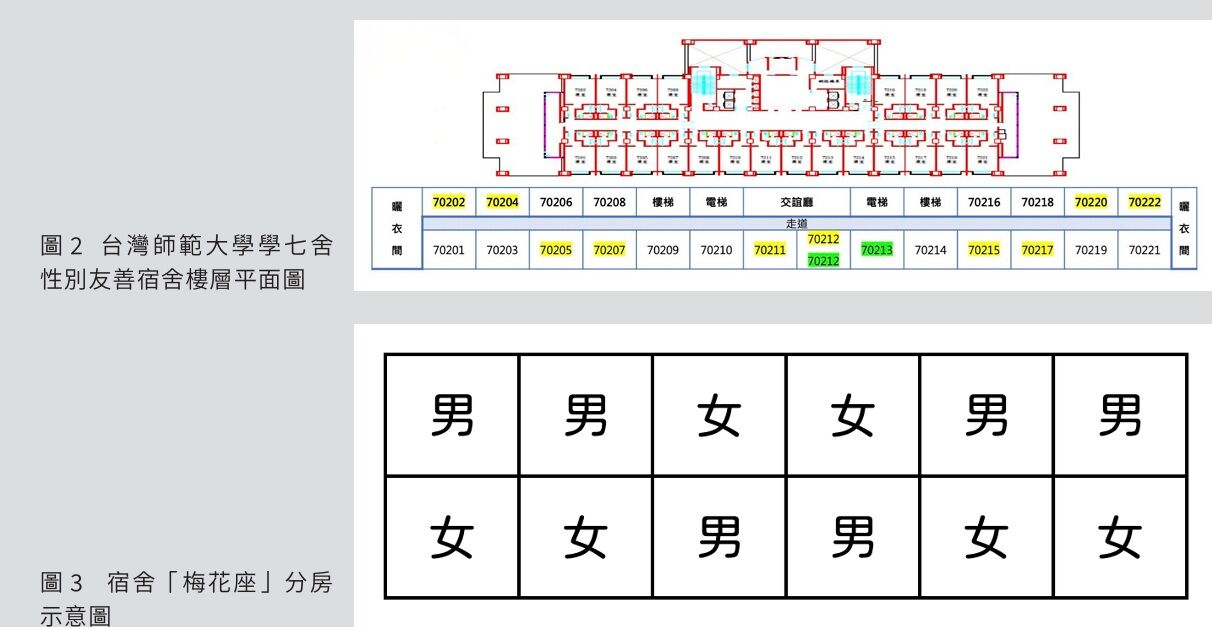
The gender-friendly dormitory at National Taiwan Normal University (NTNU). (Photo / Provided by the Ministry of Education)
Regarding the gender-neutral "apartment-style dorms," the MOE cited NCCU's Huanan New Village as an example, where 15 out of 24 units were occupied by mixed-gender groups. However, even with mixed-gender teams, the actual living arrangements still mostly maintained gender-based separation—for instance, students within the same unit would still divide rooms or floors by gender.
Although providing the reference manual and practical cases, the MOE emphasized that schools can implement these changes progressively based on their own conditions and student needs. The ministry advises schools to communicate actively with parents—such as by hosting information sessions or writing letters to parents—while simultaneously balancing student privacy with residential safety.
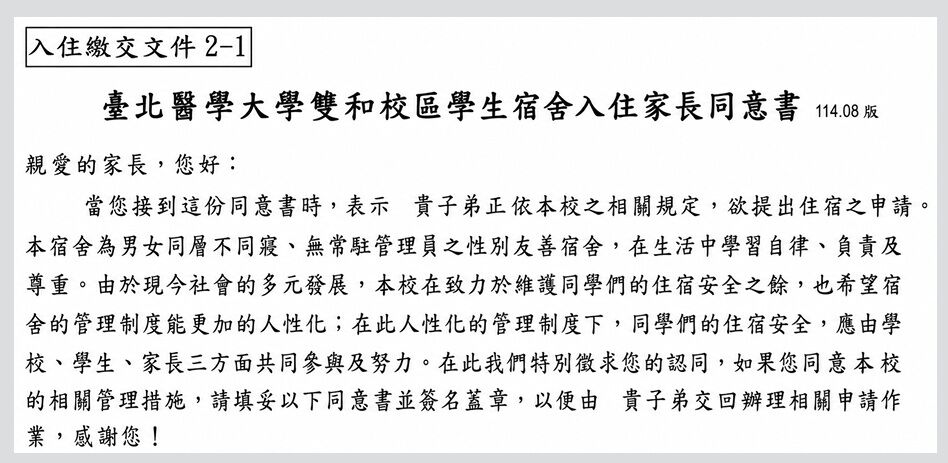
Taipei Medical University (TMU) requires students planning to move into the gender-friendly dormitory to obtain a parental consent form. (Photo / Provided by the Ministry of Education)
News Source:https://www.cna.com.tw/news/ahel/202608260117.aspxhttps://www.ettoday.net/news/20260826/3226018.htm